Celebrating Our Vibrant Community

17 May

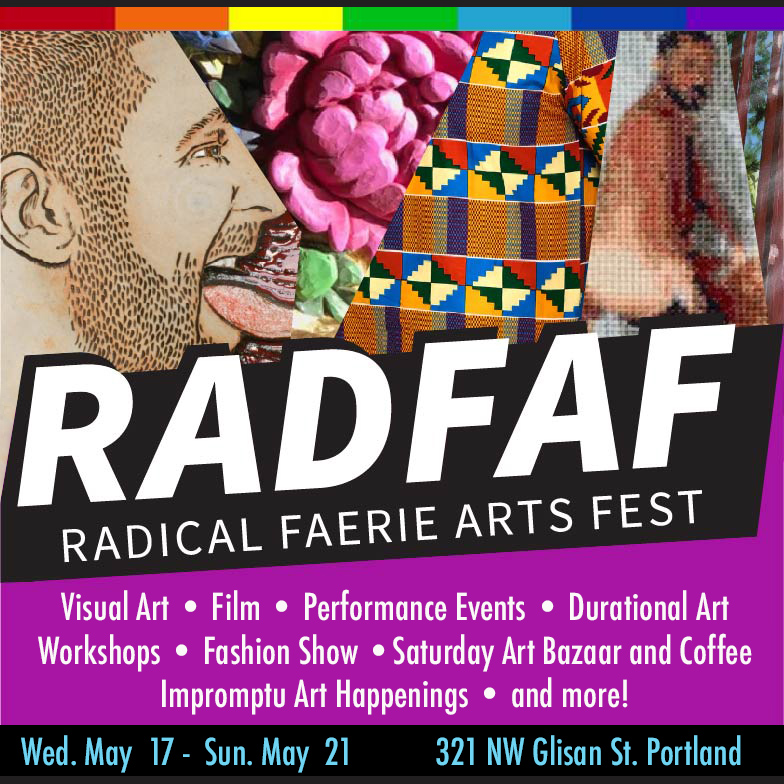
From May 17-21 the Portland Radical Faeries are putting on the first ever Radical Faerie Arts Fest (RADFAF) here in Portland at 321 NW Glisan St. The reception and opening ceremony for the event is tonight, May 17 from 5-9 p.m. The entire festival is completely free. A full rundown of RADFAF can be found here: https://www.radfaf.org

I was asked to perform at RADFAF as a performer, and believe me, I’m happy to participate. I will be performing at our spoken word event, “Faerie Reelness,” on May 18. On May 19 I will be performing at the RADFAF Music/Singer Showcase and will be opening the show.

For my artist’s statement that is included in the program, I stated the following: “I believe storytelling is a human right, not just a civil right. Anything that impedes freedom of speech imperils the rights of those who wish to tell their stories and therefore share their cultures. Storytelling is universal across all societies and belief systems, and therefore the art of telling tales may be considered both a radical and essential act.”

I look forward to seeing you at the Radical Faerie Arts Festival. Be well.

Authentic Storytelling

2 May

My latest article from Voices! Magazine is below. I’ll leave the link for the magazine itself at the end of the article. Enjoy!

What happens when you know you’re right for a part, but the role goes to somebody else?

As an actor, this is very often the case with most roles. When an actor receives a call to go to an audition, he or she will receive “sides,” or a small breakdown of the script which may or may not even be the final copy of the screenplay to memorize before they go for their audition. The role will specify the age range (i.e., 30-45 years old), gender, race, and other factors that the director or producers are looking for from the actor. Although there may be some flexibility in how the role is cast, more often than not, the director has the last word in who makes the final cut. And of course, this can be very frustrating if you actually meet all of the requirements, have a great audition, and still don’t succeed in nabbing the role.

One of my favorite examples of this happened to me in the past decade when I auditioned for a television series called Legit, in which they were looking for an actor who could play a character with a disability. The character in question was named Billy Nugent, and he had muscular dystrophy. I was told that I was in the running for the part along with at least two other actors. As I’m an actor with a facial paralysis thanks to growing up with Moebius syndrome, it was incredible to think that I might have a shot at a major role on a television series.

Only it didn’t pan out that way. Another actor named DJ Qualls beat me to it. As far as I know, the actor doesn’t have any noticeable disability in real life, but he was convincing enough in his audition that he got the part. Congratulations were certainly in order for him; the show lasted for three seasons, which I’m sure gave him a leg up when it came to finding more work later in his career. While I hold no ill will towards DJ, I was reminded yet again that simply having the right stuff doesn’t necessarily ensure that you’re the best fit for the part. And while Hollywood has made strides in auditioning more actors with disabilities to play characters with disabilities, this doesn’t mean that the actor meeting those requirements will get the role.

In fact, it’s still very common for able-bodied actors to play parts that are written for people with disabilities. The reasons vary, but in most situations, the producers are looking for a name actor to fill the part. The challenge, therefore, is in cultivating performers with disabilities who can eventually become name actors themselves. There are plenty of examples of this such as Peter Dinklage, Marlee Matlin, Linda Hunt, and Troy Kotsur, to name but a few. But in order for this to happen, authenticity in casting must take priority, because authenticity always matters.  

As public speakers, we have an enormous advantage compared to our thespian brothers and sisters: We can create our own speeches and thus tell our own stories. And we do so with our own voices, hearts, and minds. We aren’t at the whim of casting agents or producers. We don’t need to worry about television or movie ratings or the politics of Hollywood. And we have the option to be honest about who we are. The key to remember is that we don’t have to ask anyone’s permission to tell our stories. Authenticity always matters. And no one has the right to tell your story but you. When you take the time to be true to yourself, then your personal role can become much clearer.

I acknowledge that I can’t necessarily advise people on how to create their own stories as each person’s situation is unique. I’m also mindful of the fact that not everyone chooses to share their story. The best advice I can offer is that the story will tell itself when it’s ready. I’ve seen this many times when I’ve watched speakers both old and new take the podium and reveal parts of themselves I would never have guessed at. Yes, it’s possible some of them might embellish the truth, and especially in Table Topics, you have the opportunity to outright lie if you want to. But being able to hear someone else’s story is what inspires us to tell our own. Authenticity matters not only in what we say and how we say it. It matters because it allows others into our space in a way that affirms them. It matters because it inspires people to discover or own parts of themselves they may have neglected or thought others would shame them for. And finally, authenticity helps affirm the worth of what you bring to the table. Maybe you won’t be the right person for every part, but as a public speaker, you can decide how to best use your gifts and experience to your advantage.  

https://d7toastmasters.org/project/voices-april-2023/

Celebrating Diversity with the House of Mouse

28 Apr

At some point I’ll get around to writing a longer post about how ironic it is to be singing Disney music during a time when the corporation itself is under attack by Governor DeSantis for being too “woke.” For now, I’ll just thank Disney for being a staunch ally of our community for over 30 years. Our next concert occurs on June 24-25 and features musicians from the Oregon Symphony, which marks our first collaboration ever with them. I’ve included the link. I hope you’ll join us in June for a fantastic weekend full of song and Pride!

Learn to Love Taking Notes!

27 Apr

Hi all. I’ve decided to try a different tack on posting my articles. I will still put the link for the article at the end of this post, but whenever possible, I’d prefer to let you see the full text here. Henceforth you don’t necessarily have to click on the link unless I’m publishing in a magazine that requires it. And if you hit a paywall when that happens, I apologize in advance for that, but the magazines I hope to be published in always want subscribers. Please be patient as we figure this out together.

That said, I encourage you to click on the link to check out Voices! I’ve been in Toastmasters for nearly a decade, and even though I’ll continue to post my articles here, there’s plenty more to see in the magazine. For those of you who might be interested in joining Toastmasters, Voices! gives a lot of advice on public speaking and leadership. Please check it out when you can. This current article can be found on Pages 40-41 of Voices!

Now, on to the article itself!

What happens when you need to create a specific speech, but you can’t clarify all the points you want to make?

Taking notes used to be one of those tasks that I dreaded. I remember when I first learned to take notes back in grade school. At the time, I found it helpful, but only slightly. When your self-esteem isn’t that great to begin with and you’re taking classes like Social Studies where you feel profoundly stupid, the notes only served as a reminder that I had a lot more to learn. Flash forward to my adult years, and I was often asked to take notes for different organizations. Perhaps my least favorite time for note taking also became my most transformative experience for learning how to take notes correctly. From 2013 to 2015, I served on the Talent Committee at the Oregon Media Production Association where we tried to create policy and events that would help actors and other talent excel at their craft. During my first year, I was asked to take notes during our meetings. Not knowing how much information to take down, I ended up recording almost every aspect of the meeting. I was gently taught by a couple of people to summarize the different parts of the meeting by delineating the main points of each subject we covered. Gradually synopsizing the meeting became much easier, though by the time my tenure ended as secretary of our group, I truly hated note taking.

Perhaps not so surprisingly, during my time in Toastmasters, my attitude gradually changed to where I did almost a completely U-turn on taking notes. In two of my clubs, we have the meeting role of the Master Listener. Simply put, the Master Listener listens to the bulk of the meeting, takes notes on each of the speakers, and then gives a pop quiz to the rest of the club near the end of the meeting. One of the benefits of the Master Listener role is that it’s one of the easiest meeting roles to learn for newer members. However, it also provides an interesting challenge as the Master Listener also practices better active listening skills in picking up the various details of the meeting before creating questions for the rest of the club to answer. And as a better active listener, you’re more likely to catch details in the speeches you might have missed otherwise that might prove invaluable to you later as a speaker. As the Master Listener, I used the skills picked up from my time as the committee secretary, took meticulous notes, and enjoyed stumping our members and guests by giving very specific questions related to our meeting. I learned just as much from the experience as they did.

Perhaps the best time for me to take notes is when I’m brainstorming. I love brainstorming, and as someone who writes in multiple genres, brainstorming is a must in most situations to help clarify what it is you want to write. Unlike other forms of note taking, brainstorming is much more freeform, allowing greater flexibility but also eventually needing a way to organize one’s thoughts into a coherent story once you’ve hashed out the details. For example, world-building is one of my favorite activities as a writer of science fiction and fantasy as so many elements go into creating a milieu that is exciting to both the reader and the author. The main drawback in world-building is that you can become lost in your own creation and forget to write the story itself. Brainstorming should ultimately be about creating the environment you want for your speech or essay. I learned that If you’re spending too much time brainstorming, you’re probably overthinking what you want to do on your project. By taking the time to create the main points of my story or speech, I was able to flesh out my goals much more succinctly.

While I can’t always tell you that there are ways to enjoy note taking, certainly there are many benefits to using this skill. As our Club Secretary, for example, I’m able to take part in the direction of my club by recording the events of our executive committee meetings. And that’s perhaps the biggest takeaway. By taking notes for yourself, you ensure that you retain information for a longer period of time so you can improve your skillsets, whether that be as a student or an employee. By taking notes for others, you ensure that the group remains on track and accountable for their actions. And by using note taking as a means to create a speech, you make it possible to keep the speech on-topic by creating bullet points for your subject matter, making it easier for your audience to follow along.

Voices! March 2023

Unique Qualities to Unique Situations

29 Mar

A friend of mine recently asked me the question, “Where are you uniquely suited to offer the most value to others?”

Although I don’t like harping on my facial paralysis too often, I was recently thinking about how I could use my disability to my advantage as an actor. This way of thinking has not always come easily to me. Years earlier, just after I was signed to my talent agency, I was trying to think of ways to avoid having to use my disability, believing that it would be a crutch in finding employment. Actors with disabilities still find very little work in show business, and I was determined to show casting directors that I was more than my disability. However, when you go out for auditions, the casting directors will use what they see, and you only have two minutes (at best!) to showcase what you have to offer. In recent years, there have been more opportunities for actors with disabilities to be seen and heard, and I finally decided to work on finding ways to use my facial paralysis to my advantage.

One of the things that I’ve been wondering about is what it would be like to work in motion capture. In motion capture, sensors are attached to the face and body in order to record the actor’s movements and facial expressions to be used later in animating or enhancing specific characters. An argument could certainly be made that I’d be a poor choice for this performance technology, but then again, no one has ever tried to capture my expression in such a way, either. What would it be like for the technicians working with me if they found that a person with my facial paralysis actually had more going for me than they thought, especially given my many years of performance experience? The idea I’m playing around with is putting together an article called, “What Can You Learn from a Facial Paralysis?” At the very least, I can offer insights into different disabilities. At most, I might be called upon as a disability consultant in show business, though for various reasons that I won’t go into, that situation is fraught with peril, especially since many people with disabilities don’t get properly paid for their services in the industry.

Our Next Concert Is…

22 Mar

I’m pleased to announce that the Portland Gay Men’s Chorus will be performing our next concert, “The Body Electric,” on March 25-26 at the Patricia Center for the Performing Arts in Beaverton, Oregon. Saturday’s concert will begin at 8 p.m., while our Sunday matinee starts at 3 p.m. A full description of the event appears below, and you can get your tickets here: https://thereser.org/event/the-body-electric/

The Body Electric

March 25-26

We, the Portland Gay Men’s Chorus, loudly proclaim that all people have the right to lead lives of freedom, peace, and joy. In these tumultuous times, The Body Electric honors our communities’ never-ending crusade against oppression, the pursuit of a more perfect union, and the inalienable power found within each of us. Join us as we raise our voices in celebration of all that we are and all that we hope to be.

“BE ADVISED: Laser and/or strobe lights are used throughout this performance. Audience members with photosensitivity or a history of seizures/epilepsy may consider caution.”

Say What You Mean!

1 Mar

Hi folks. In my latest installment in Voices, I talk candidly about how euphemisms, slang, and expletives can cause confusion for your audience. As public speakers, it’s always better to strive for clarity and never assuming what the audience might or might not know. Tomorrow I’ll talk a bit more about my favorite euphemisms and why they can cause more harm than good. You can find my article on Pages 38-39 of Voices! Enjoy!

https://d7toastmasters.org/project/voices-february-2023/

New Beginnings

27 Feb

I’ve been working very hard over the past several years to work on my writing with an eye toward publication in a number of different periodicals as well as creating books and screenplays. Writing has always been my true calling, but up until recently, I’ve felt like I had to please other people or work in “mainstream” jobs in order to make ends meet. To some extent, the latter is still true. I’m job hunting for work in several areas, and I plan to be employed again by the middle of March. However, the primary goal is to make a living as a writer, and so I decided to make a promise to myself to write five hundred words a day, minimum. That starts right here with this blog.

The main goal is simple: Write five or more posts a week, Monday through Friday, and preferably as early as possible in the morning. I plan on covering a variety of topics, but the idea is simply to create a habit of writing every weekday. I reserve the right to have weekends off if I need them, but if all goes well, I may find myself writing seven days a week, which is just fine with me.

Some of you might be wondering why this is so important to me. In a nutshell, writing is the first thing I want to do every day I get up in the morning. The desire to write follows me throughout the day by reminding me of stories yet untold that I’ve recorded in my journal. At the gym I might skip socializing in the swimming pool during water aerobics because I’ve had an idea for a screenplay that needs retooling. And at bedtime I’m thinking about superheroes and the various ramifications of having superpowers. In summary, writing matters, and it’s the one form of employment I feel most qualified at doing, despite having over twenty years of experience in medical and general transcription.

It should be noted that the five hundred words I write a day might not all be in the blog but rather spread out throughout the day in various projects. In addition to writing essays, fiction, and screenplays, I also enjoy writing on a website called Quora. You can find me on there answering questions and maybe posting a few of my own. I look forward to hearing your responses to my writing should you choose to leave comments, and you can also hold me accountable if I don’t make a posting on a given weekday. See you soon.

Facing My Fear of Failure

3 Feb

What’s the thing you’re most scared to do? What would it take to get you to do it?

I’ve known since the age of four years old that I was meant to be a writer. When
my brother and I were much younger, we both loved to listen to our mother read to us.
Eventually I told her that I wanted to start telling my own stories. She would
write down what I said, and I would get very upset when she wouldn’t put the
right words on the page. Later on, our mother would create “books” for me by
stapling together a few sheets of typing paper, and I would begin writing my
thoughts and stories down. (Yes, this was long before the age of personal
computers, and it wasn’t until high school that I would take typing classes,
which to this day I have never once regretted doing.)

The thing that was so unusual about my writing, especially according to
my parents, was that the punctuation and spelling were perfect. No one knew how
I was doing this at such a young age, and it was a strong indicator that
despite my facial paralysis, I wasn’t at all intellectually impaired, despite
what doctors had told my parents several years earlier. My uncanny facility with
language led to me being placed in the talented and gifted program at school,
which is one of the few places I thrived in for quite some time.

The thing is, I’d dealt with a lot of people underestimating me, especially
during my younger years. This impacted how I saw myself, of course, but worse
than that, it meant that I couldn’t trust my own voice. Even though I had the
support of teachers and others who could see my potential as a writer, it took
me many years to realize that I had something of value to say. Thankfully, in
the past few years through a number of different circumstances, I realized that
I wasn’t living the life I most wanted and began to write again. My blog in
particular is an ongoing project that is meant to be the centerpiece of a
number of activities including acting, singing, public speaking, and of course
the writing itself.

Writing is its own act of defiance and helps me face my fear of failure. Each day I
sit down to write is a day of repudiating that fear and making sure I don’t
give in to doubt or insecurity. Some days I may simply not know what to write.
On other days, several projects may clamor for my attention all at once. Sometimes
I’ll go onto Quora, a website where people pose questions and get answers to
them, and jot down my own responses to various inquiries. The point is to keep
writing and eventually find my own voice, regardless of what my insecurities
might be trying to tell me.


It’s Complicated

2 Feb

I’ve been a member of the Portland Gay Men’s Chorus for over 30 years, joining in 1992 straight out of college. I’ve also been privileged to be a member of our subgroup, Cascade, several times over the years. Cascade is a smaller ensemble of singers who perform both at our regular concerts as well at for outreach events. Cascade will be performing their next concert at the Alberta Abbey, 126 Northeast Alberta Street, Portland, OR, 97211 on February 11 from 8-10 p.m. The description of the concert as well as our website information are below. I hope you can make it.

From the Portland Gay Men’s Chorus website:

“Let’s face it – sometimes Cupid’s arrow misses its mark or strikes the wrong target, love’s rosy path hits a bramble patch, or the planets simply fail to align. Taking a chance on romance can feel like a fool’s errand, but we plunge in headfirst anyway. Come fall in love with Cascade all over again as we explore the many moods of this thing called love.”

Tickets can be purchased at the Portland Gay Men’s Chorus website: https://www.pdxgmc.org/concerts-tickets/