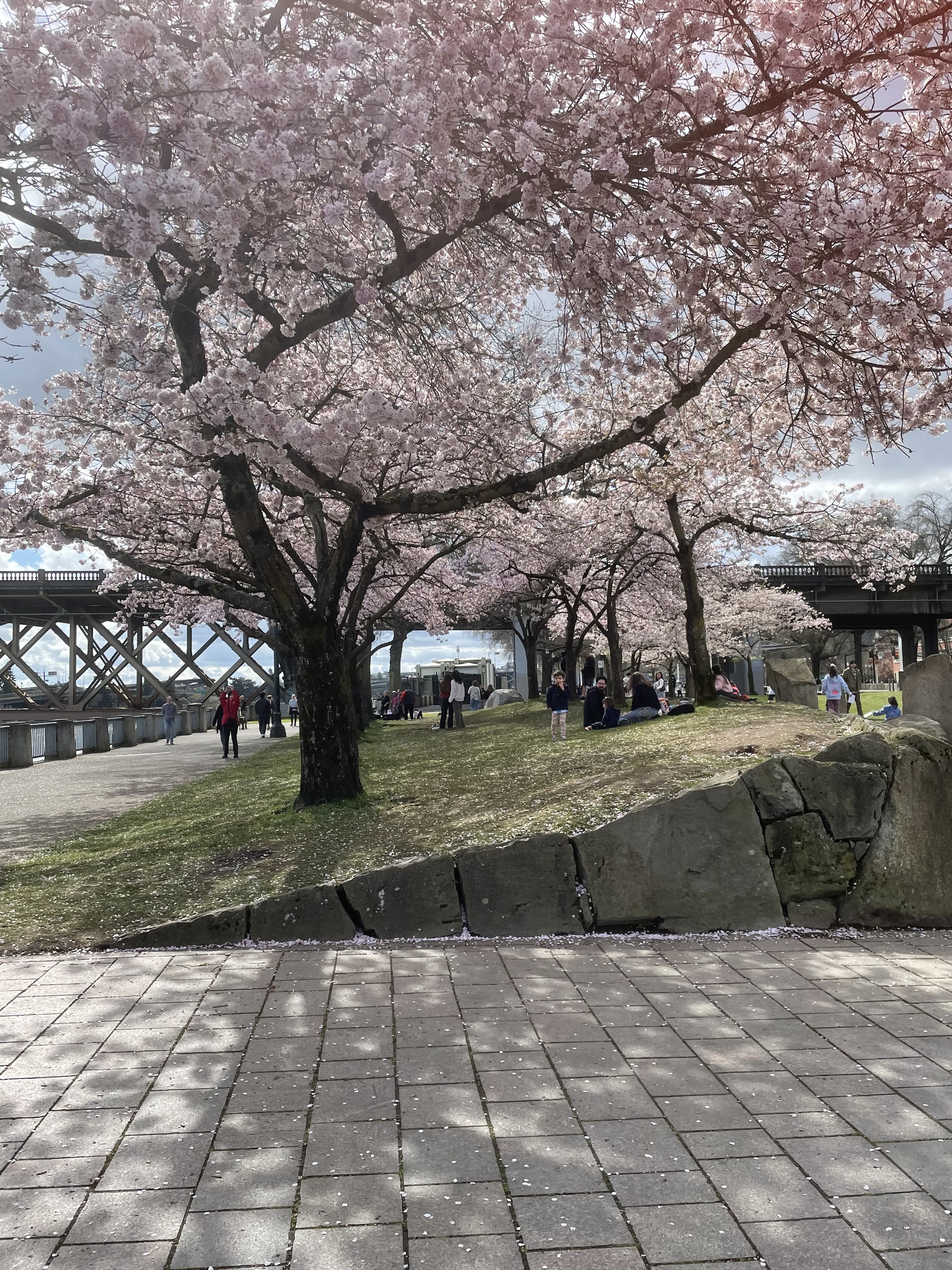
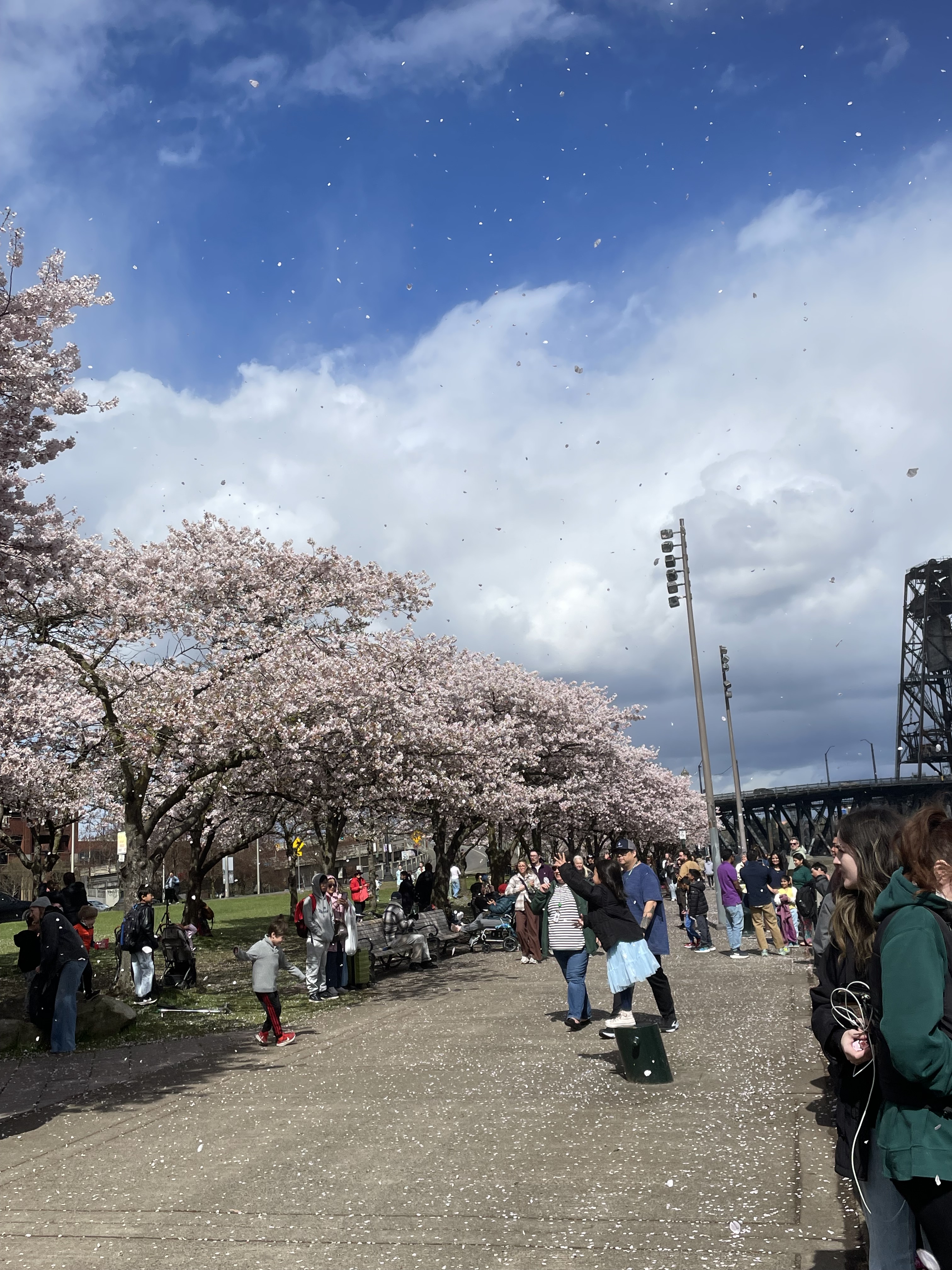
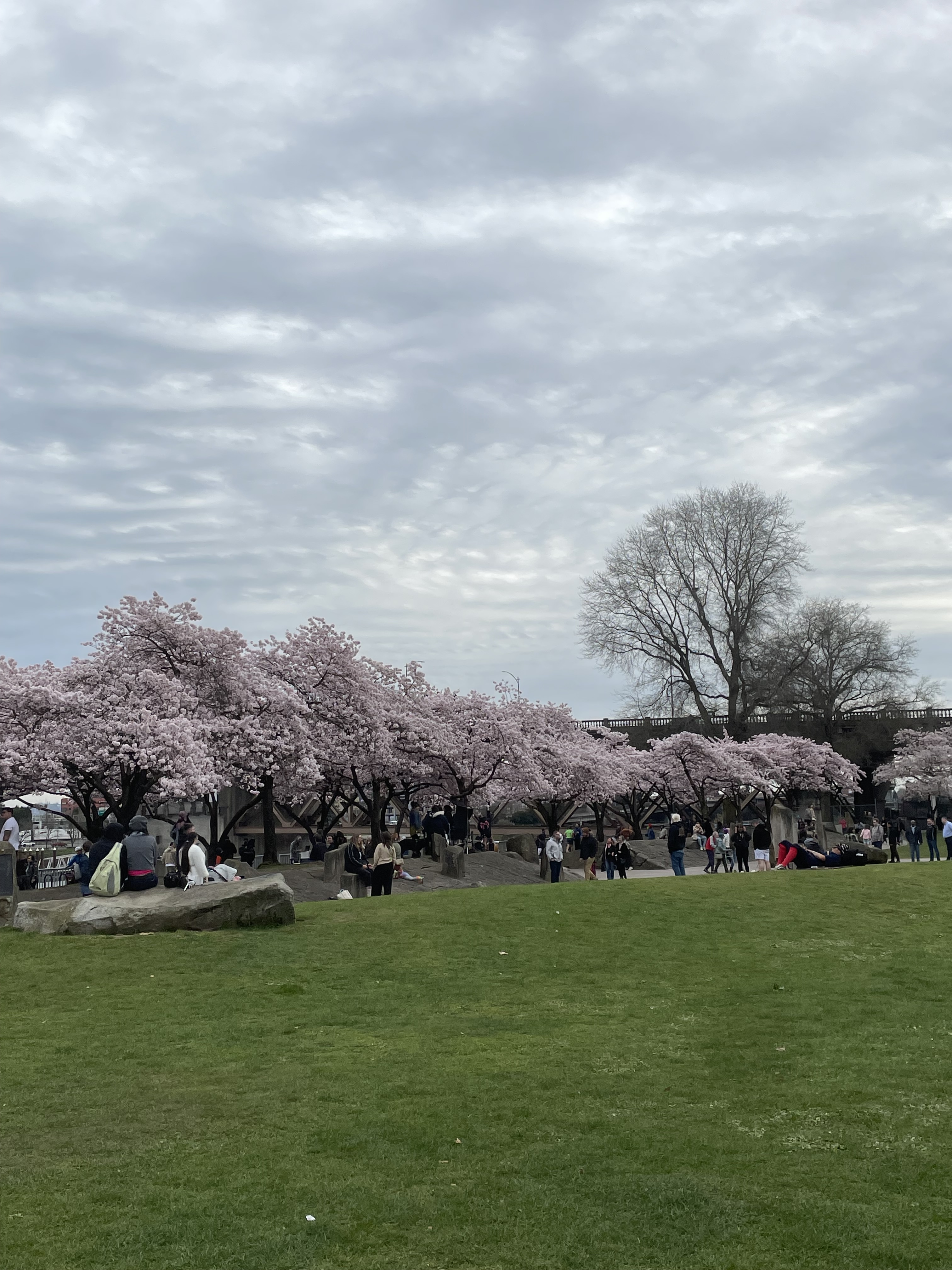
I thought I’d start April with a very short post. Spring has always been my favorite time of year, and never more so than when I get to visit Portland’s Waterfront Park. At the Japanese American Memorial Plaza, the cherry trees come into bloom in mid to late March. Over the past few years, I’ve made it a point to visit the Plaza to enjoy the spectacle and take a few good pictures. This year was no exception.
I’d like to offer a prayer for all of us throughout this season. I recognize that we are living in interesting times, to quote an old Chinese curse. Yet if spring has taught us anything, it’s that all of us deserve to have a season of growth and renewal. We may not all be on the same journey, and we might find ourselves at odds with others because of our values and circumstances. Yet all of us are still searching for what makes us whole. My wish is that we manage to find some peace within the chaos of our lives and that we can allow ourselves some forgiveness if we can’t measure up to the challenges we face. All of us need to take stock once in a while, and springtime assures us that better days are ahead. We just have to be willing to plow through the winter first before sunny skies and cherry blossoms appear again.
I’ve been a performer my entire life, and I’ll acknowledge that one of the things I really wanted when I was younger was to be famous. I couldn’t really articulate those reasons no matter how hard I tried; it was simply a case of the grass is greener on the other side.
On the other hand, having been born with Moebius syndrome, I knew that finding work as a performer would be quite challenging given that my bilateral facial paralysis might be off-putting to producers or casting directors. I suppose in a way this helped to ground me, for at least I knew my limitations and was wise enough to realize that being famous wasn’t a guarantee, no matter how hard I worked in the field I loved. I certainly knew that finding employment in show business as a person with a disability would be a daunting task in and of itself, and for a while I simply didn’t look for work at all.
Thankfully, I learned a couple of valuable lessons in high school. First, if I tried seeking popularity, I wouldn’t get very far. However, if I focused on nurturing those interests that I loved, I would receive recognition for them simply because I wanted to succeed in those areas rather than worry about people’s opinions of me. Another lesson that I took away from high school is that the popular kids aren’t always the happiest. Maintaining one’s standing in the social hierarchy of high school isn’t easy, particularly taking into account peer pressure and the desire to fit in. Now think about fame as being the ultimate expression of belonging to the “in” clique, with many more perks but twice as many hangups. Your privacy disappears, people’s judgments can directly impact your popularity, and you won’t always know who your friends are.
For myself, I prefer to be reliable rather than famous. Being reliable in this instance means being punctual, polite, and prepared to work. I often find this to be a better alternative to being popular simply because this is well within the framework of what I can relate to. I can’t always control what people think of me, but I can certainly control my reactions to their behavior. And if I’m working on activities that I enjoy or can contribute to other people’s projects in a meaningful manner, that far outstrips anything I might acquire if I were famous. I’d rather be that person who people always come to because they know they can count on me for having a strong work ethic than be the “it” guy. Frankly, most people who are in the spotlight can have their careers taken away at any time simply by being replaced by the next up-and-comer. It’s harder to be replaced when you’re the expert the other experts rely on.
I think Clint Eastwood said it best: “Chasing fame is like chasing ashes blown by the wind; it neither ignites a fire nor stays put.” When push comes to shove, fame is notoriously unreliable. It doesn’t necessarily guarantee steady work, and it can dry up very quickly. I’d rather focus on being a solid member of my community who can be counted on to show up in all the right ways where it counts the most.
In putting together this concert, a great deal of consideration was given to the fact that we are celebrating the 30th anniversary of one of the seminal works out of GALA Choruses, NakedMan. NakedMan in its entirety describes the experiences of what it was like to be a gay or bisexual man in the time of AIDS. While you will not hear the majority of the commission this evening, “Legacies” includes commissioned works from other GALA choruses which also cover many of the themes included in NakedMan. I wish to thank the composers Robert Seeley and Robert Espindola for creating this outstanding piece of music.
I’d like to take a moment to recognize the following: Many of you in our audience have never had the opportunity to hear NakedMan. In fact, quite a few of you are from a generation that has never felt the impact of AIDS. The closest analogy that any of your generation can relate to is the recent Covid-19 pandemic. Even here, however, there are marked differences. Covid-19 sparked a massive worldwide lockdown and a desperate search for a vaccine that would eventually slow the spread of the disease. Not so with AIDS. For years, AIDS was considered to be a gay disease, and thus an entire population of people was decimated by the virus both before and after President Ronald Reagan finally acknowledged the disease’s existence in 1987 after the death of his friend, Rock Hudson. Eventually, research was started in the hopes of finding a vaccine for the disease.
As of 2026, there is still no cure for AIDS.
I can tell you that there are countless stories about how each of our members has dealt with AIDS, homophobia, religious fundamentalism, and worse. Indeed, this is the concert in which I wish we could explain what it was like to live through the AIDS crisis. With such a short amount of time allotted to us, I would like to instead like to acknowledge the one lesson that we can impart to our audience in the two hours we have with you: Our voices matter. Especially in these times, when civil rights laws are failing us and we are beset by many people who would see our communities suffer, this is our time to sing out. We’ve learned this lesson the hard way many times over through the AIDS crisis, ballot measures put forth by the OCA and other groups, and more. And still, we sing. We have taken the lessons of the civil rights movement to heart in recognizing that when we protest together, we create an indomitable force of change that is impossible to ignore. By being present here, both as audience members as well as through the partnership of our combined choruses, we stand strong as a unified community that is working tirelessly for change and equal rights. Thank you for joining us.
As promised (albeit a while ago), I’m putting videos of my prior public speaking experience here on my blog. The goal is to start making a living as a public speaker beginning in August. I will gladly take lower-priced work for now but eventually will raise my prices as more work comes in.
The following videos were created on different subjects over the past few years. In 2021 I took part in a guided conversation put on by the Portland Gay Men’s Chorus’ DEI committee, of which I’m a member. Reid Vanderburgh, Santo Cavallaro, and myself all presented different aspects of living with disabilities and how frought life can be when dealing with stereotypes and misunderstandings. My portion of the video lasts approximately 17 minutes. Please take the time to watch the rest of the video if you’re willing.
The second video was created during the pandemic and appropriately focuses on “How to Create Better Stage Presence on Zoom.” I hope you enjoy it and gain some useful information that can help you create better presentations on Zoom or other platforms.
The Portland Gay Men’s Chorus will be performing its ICONS concert this Saturday, June 21, at 7 p.m. at the Arlene Schnitzer Concert Hall. In our performance we will be showcasing several different storytellers depicting different aspects of our lives in the LGBTQ+ community. While my piece wasn’t chosen, I decided to share what I wrote here as an example of what you might see during our concert. In the section entitled “Breaking Barriers,” we were asked to tell the audience about a time we “broke through” in some way such as an achievement, transformational conversation, or just a monumental event relevant to our LGBTQ+ experience. My answer to that question is below.
Long before I’d learned the word “intersectionality,” I was very much aware that I lived in several distinct communities. Unfortunately, I also knew that I’d likely be facing various levels of prejudice simply by belonging to them.
I was born with an extremely rare neurological disorder known as Moebius syndrome which left my face bilaterally paralyzed. Because so few people knew what Moebius syndrome was, I was subjected to a great deal of bullying and misunderstandings from people who thought that I was mentally impaired. Even though I had a strong support system at home, I still suffered from crippling self-doubt and fear about how others perceived me.
When I came out of the closet at the age of fourteen in 1983, I was already aware that being out at that time was incredibly risky. Although I came out of the closet to my mothers and some close family friends, because of my prior experience of being bullied, I had no desire to face even more prejudice against me and didn’t tell many other people at first. As a result, my coming out process was a slow one, which ultimately culminated with me joining the Portland Gay Men’s Chorus in 1992 and becoming almost completely out of the closet in the process.
About two years after joining PGMC, while driving home with my stepmother, I turned to her and said, “You know, I’ve counted five ways that people could be potentially prejudiced against me. I’m gay, disabled, Jewish, short, and left-handed.” My stepmother thought about this, then turned to me and said, “Well, yes, that’s true that people might discriminate against you. But what would happen if you looked at all of these things as gifts?”
That thought floored me. I’d learned to accept the various pieces of myself over the years, but many times they’d felt like obstacles to be overcome. Not once had I ever felt that these components of my life were gifts. I don’t remember the rest of that conversation. I only knew that my self-perception had been upended by a very timely insight.
Today, many years after that conversation, I now understand what my stepmother meant, and it taught me an important lesson: Sometimes, for you to best see yourself, it takes an act of compassion from another person for you to best recognize your gifts.
Our upcoming concert, ICONS, celebrates the artistry of LGBTQ+ musicians from past and present. Please join us on June 21 at 7 p.m. at the Arlene Schnitzer Concert Hall as we turn the stage into a grand nightclub showcasing our finest talent.
Every year I make an effort to go down to the Waterfront Park in Portland, Oregon to capture on film the blooming of the trees. Throughout much of my adult life, I’ve made it to the park without fail, but it’s only in the last few years that I decided to photograph the event. And every year, I wonder what would happen if the flowers didn’t bloom.
There’s a very old myth about how the seasons came to be. In Greek mythology, the fertility goddess Persephone was kidnapped by Hades in order that he might make her his bride. There are several variations on this myth, but for the sake of brevity, after eating a pomegranate, Persephone was required to remain in the underworld for a set period of time – usually three months, but sometimes more depending on the the number of seeds eaten and according to who is telling the story. Her return heralded the beginning of spring, at which time her mother Demeter rejoiced at her return. Persephone’s return to the underworld signaled the beginning of winter.
But what would happen if the flowers didn’t bloom?
Each year I watch the trees as the buds start to sprout. What would happen if they didn’t emerge, or the buds remained in stasis rather than fully growing into leaves? How would this affect our outlook if spring never came? It may sound a bit silly at times as many of us take spring for granted, but I often look at this season as my favorite, as well as the most ephemeral. The beauty of spring is offset by its fragility. The cherry blossoms bloom once a year and then vanish. The birdsong begins and continues throughout the summer as they find their mates before flying away in the autumn. And no spring is ever completely the same.
If Persephone chose to maintain her residence in the underworld for a longer period of time, I imagine the spring season would be very brief, and summer would begin sooner. I have no doubt the harvest season would be affected as well. And of course the length of spring changes in different climes anyway, including here in the United States. Our spring here in Oregon is quite different from what you might see in Minnesota. But if Persephone never returned, the flowers wouldn’t bloom, and many of these seasonal changes wouldn’t come to pass. We’d see a much more barren planet than we’d ever want without the advent of spring and the return of the crops we need for our very survival.
I celebrate spring for many reasons. The return of warm weather and the blossoming of the cherry trees are only a very small part of it. I celebrate the return of possibility and growth, even though I’m aware those things have never really left us. I celebrate spring for the renewal of romance or of finding of new love. But mostly, I celebrate it because the alternative is that we remain in stasis, forever immutable and depriving ourselves of new opportunities for changing who we are, even if those changes are necessary or inevitable.
Our joint concert is coming up in less than ten days. The Portland Gay Men’s Chorus, the Portland Lesbian Choir, and the Portland Pride Bands will be performing at the Arlene Schnitzer Concert Hall in our spring concert, “Our New World,” on Sunday, March 30 with our special guests, Bridging Voices. Tickets are almost sold out, so if you’re still on the fence about going, don’t delay. There are still some seats left on the upper balcony, so snap them up as soon as possible.
Below is an interview on AM Extra with all three of our conductors: Dr. Braeden Ayres, Mary McCarty, and Joseph Accuardi-Gilliam. Enjoy!
At last, it’s come to this. I have so many video games at home, both physical copies as well as from the various libraries on my systems (Playstation Plus, Nintendo Online, and Game Pass) that I’ve decided to drastically cut down how much I spend on this hobby. I’d already reduced my budget for video games anyway for various reasons, but now that I have a huge backlog, I’m much more likely to simply finish up what’s there. In addition, any “new” games that I want to get can be downloaded from those libraries, meaning that I’ll only spend money on the games I want once every few months.
I’m actually overjoyed with this decision since it’s been obvious for a while that there’s no conceivable way to finish every game in my collection for at least a year unless I have more time freed up. Additionally, with the job hunting, finishing the test for my medical billing and coding certification, and other activities keeping me busy, that’s not going to happen anytime soon. So yes, having more money available due to less spending on my hobbies isn’t necessarily a bad thing.
I’m implementing a similar strategy on buying more books as my library has grown substantially, but my book space is at capacity. There’s only one book that I’m currently looking at buying, Ursula K. Le Guin’s The Books of Earthsea: The Complete Illustrated Edition, and it’s big enough that I’d have to clear out more space than I have now. Knowing when to say no to buying more things has been an essential lesson I’ve learned while being unemployed. I’m committed to being more frugal than ever for the next year, even when I eventually obtain a new job.
On March 30, 2025 the Portland Gay Men’s Chorus is partnering with the Portland Lesbian Choir and the Portland Pride Bands with our special guests, Bridging Voices, for our spring concert, “Our New World.” Tickets are selling fast, so please reserve your seats immediately. The discount code is FAFD10 and will end March 17 (St. Patrick’s Day).
The link for the PGMC website is below. I look forward to seeing all of you at our upcoming concert.