On Facing My Fears

10 Oct

I’ve been an artist for a long time. Specifically, my main areas of focus over the course of my life have been writing, singing, acting, and public speaking. Interestingly, however, I’ve very seldom thought about my “why” for each of these creative endeavors. With writing, I’ve always felt the need to write. It truly is my calling and can keep me up late at night or wake me early in the morning with a sentence or story tugging insistently at my consciousness. My desire to sing is almost as persistent as my calling to write. I don’t try to assign a reason for my singing beyond the fact that I truly love doing it. My public speaking experience came about as a result of my wanting to become a better actor. As a public speaker, my “why” is to be a better communicator and eventually educate people on a variety of different subjects.

Acting, however, has been a different beast altogether, and for a long time I’ve been very conflicted on where to go with it. I knew since I was a teenager that I wanted to create an acting career, but the reality is, my bilateral facial paralysis was always going to be problematic in terms of finding work as an actor. Even when I make the effort to speak more clearly, the lack of facial expression at best relegates me to being a specific type of character actor and at worst being treated as not much more than a stereotype. In some ways, this caused me even more headaches and sleepless nights than the stories that would flit through my head. I would often wonder, how do I create a career for myself as an actor when the odds are seemingly stacked against me because of my disability?

I’ve mentioned this next point in prior posts, but I’ll briefly restate it here. In 2007 I was inspired to go back into acting after reading an article about the successful career of another actor with a disability named Robert David Hall. Almost immediately after finishing that article, I sought out a teacher in television and film acting who in due course became my agent. In addition, I also began researching other performers with disabilities in order to discover how they succeeded in an industry where people with disabilities can often be overlooked or treated as a joke. Not surprisingly, if you do enough research, you’ll find that there are plenty of performers with disabilities in the entertainment industry. However, if you asked most people on the street to name five performers with disabilities, you’d probably get a few blank stares and maybe, just maybe, one or two responses to that question. And I guarantee you that very few of those performers with disabilities are working in any given year compared to their non-disabled counterparts. So while I was encouraged to find successfully working performers with disabilities in show business, it was disheartening to realize that we weren’t well-represented, let alone acknowledged for our accomplishments very often.

With all this in mind, even after getting an agent, I was justifiably terrified of going to auditions. I made some progress and scored a couple of projects very early on, but my fear eventually took over. There were times when I’d receive a notice from a casting agency, whereupon I’d look at the project and think, “Why would they think I’m perfect for this?” I would then blow it off and miss an audition thanks to my fears of how I’d be perceived as a person with a disability rather than realizing that the people who sent me the project notice already had access to my profile and realized I might be a good fit for them. In other words, I was a victim of my own self-sabotage, and I hated myself for it.

The inciting incident that turned things around for me was the pandemic as well as the realization during that time that I needed a hard reset with how I was doing things. My writing received a boost when I agreed to create a column for Voices! Magazine in 2021. My singing had never stopped, even during our isolation during the pandemic, as the Portland Gay Men’s Chorus created virtual concerts to supplement our season, ensuring that our audiences would still be able to see us. I kept active in Toastmasters as well, becoming an Area Director for a third time and attending all of my meetings virtually. But what was I to do about acting?

To this day, I’m still not completely sure how my acting career will work out, but figuring out my “why” was of paramount importance so I could create a more secure space for myself. Ironically, my “why” isn’t about security at all but instead its exact opposite: I act in order to face my fears as a person with a disability and to work past my concerns about how people perceive me. I act because I know there aren’t a lot of other people out there like me with facial paralyses who are working performers, and if I can be successful in my field, then maybe it will make room for other performers with disabilities to do the same. And I act because, frankly, it beats working at a desk in a crappy job that I hate. Yes, I know I could still go down that road, particularly since I’ve almost finished up my certification process as a medical biller and coder. But I’ll leave some grace for myself in that regard since I need a day job like everyone else to foot the bills to support myself as a writer and performer. I act because it matters to me, and maybe it will matter to other people who need to see positive representation in the disability community as well as in the larger society as a whole.

I don’t claim to have all the answers when it comes to finding or maintaining work as an actor. The one bit of reassurance I can give myself is that I’m not alone in facing my fears when I go out for a part. I see the nervousness in every person’s face when they go up on stage, and I know that nine times out of ten most of us will be rejected. But at least now I know why I perform as an actor, and maybe that’s enough to help me take the next few steps forward in creating a successful acting career for myself.
Out with the Old…

3 Oct

Hi folks. One of the things I’ll be working on is adding new video links to my website. These will be focused on acting, singing, and public speaking projects that I’ve been involved with over the years. A few things might be taken out as well, including some older singing videos that were adequate to view then but don’t represent some of my best work now.

One video I’m proud to include is fairly recent. During the pandemic, I had the privilege of running a breakout session at one of our Toastmaster Leadership Institute events. The breakout session, entitled “How to Create Better Stage Presence on Zoom,” allowed me to explain to other public speakers and leaders how to create a space that works best on visual media. Of course, at the time we were all cooped up and couldn’t communicate in person as much as we would have liked. I have a feeling that a lot of these tips still work well today. Please feel free to share this video with whomever you feel would make the best use of it. Cheers!

Who’s Your Inspiration?

28 Sep

Sometimes It’s really important to remember the things that inspired you to move forward, especially when you’re feeling down or comparing your life to someone else’s successes. This article appeared in the summer edition of Voices! Magazine. The link for the magazine is below. I hope you enjoy it.

Minding the Gaps

27 Sep

It’s been a while since I posted. I’d like to think it’s because I was in school this past year working hard toward obtaining my certification in medical billing and coding, but I think part of that absence was based on fear. When you’re a writer and you also need to have a day job for a living, there’s a temptation to think, “Am I doing the right thing by writing even though I need to focus on my regular career?” The essay I wrote for a future issue of Voices! addresses this very topic. Please read on below.

Why should I feel guilty about doing something that brings me joy?

In September 2023, I decided to go back to school to become a certified medical biller and coder. I’d been out of work for a year prior to my return to college, and I was fed up trying to find employment in fields outside of medical and general transcription. Simply put, nothing was working, and I felt lost and confused. I had many qualifications that would put me in good stead with the right company or organization, but nothing was clicking. So back to school I went, and for the most part, it was a tremendously positive experience. I received high marks in my classes, but more importantly, the subject matter was engaging and allowed me to expand my skillsets in several different ways. Much later, I realized that going back to school also restored my confidence in seeking out and completing challenging tasks, an important factor since looking for work was one of the major stumbling blocks I still faced.

Yet despite restoring my confidence, one of the things that bothered me during this period was that I was not necessarily focusing as much attention on my writing as I thought I should. I knew that I needed to find a day job commensurate with my talents and abilities, and certainly medical billing and coding would be an appropriate choice for me to pick. But the one thing you sacrifice toward learning a new skill is time, and in going back to school, I knew that I might not work as hard toward being a professional writer. This turned out to be the case. My blog was put on the back burner, and most of my writing consisted of me either posting answers on Quora or occasionally working in my journal. Looking back at the progress on my blog, it bothered me how long the intervals were between posts. It wasn’t until I finished up with most of my schoolwork that I realized I needed to be more forgiving to myself.

Even when I started worrying about the times between writing gigs, I’d remind myself that at least some of my skills had been enhanced through creating essays for my classes. In fact, those reports were often the most enjoyable assignments I had since they allowed me to be creative. Furthermore, in my coding class, my public speaking skills came to the fore. For the first two terms, as a final project, my teacher had us create videos describing how we would code for different diseases or conditions. I jumped at the opportunity since this utilized my writing and public speaking talents in an educational manner. In short order, I created videos about coding for AIDS as well as Moebius syndrome, the condition that caused my face to be paralyzed since birth. Both videos received high marks, and my teacher asked me permission to use the video about Moebius as an example to show future coding students. In addition, it turned out that my teacher had been in Toastmasters previously and thoroughly enjoyed my work as a speaker, even suggesting that I use my talents to help create voiceover work for other coding videos. Thanks to her advice, I plan on following up on this lead very soon.

Whenever you’re dealing with members who are struggling with their educational goals, it’s important to remember that many times they will be facing similar situations of how to tackle speeches or participate in meetings. A lot of times, these members may be dealing with fear or guilt in not being able to participate fully because they’re too nervous to ask for help. At other times, life gets in the way and makes it harder for the members to be as active in their clubs as they’d like. Learning to respect the needs of those members as well as finding ways for them to feel as though they’re part of the group, even if they don’t always feel like participating, is crucial to their social and educational development.  A lot of times, newer people may feel as though they need to mind the gaps and avoid doing something that would be potentially embarrassing or humiliating for them. Taking the time to mentor our members and ensure that they have a safe space to practice their skillsets allows them to take further risks and work through their doubts.

My educational journey was enjoyable and helped me build confidence in finding work in another field. However, I also noted that even though I worked hard toward defining the skills which would allow me to be employable, I also needed to be focused on my own talents that worked well for me and in the process work past the belief that I shouldn’t have a job I enjoy. Thankfully, I received some surprising support from my teachers which allowed me to find new opportunities in my day job as well as my avocations. Ideally, you should never feel guilty about doing something you love. Even if you need to take some time away from your passion, you may find some surprising benefits from working in other fields that can add value to your craft in the long run.

Celebrating Our Vibrant Community

17 May

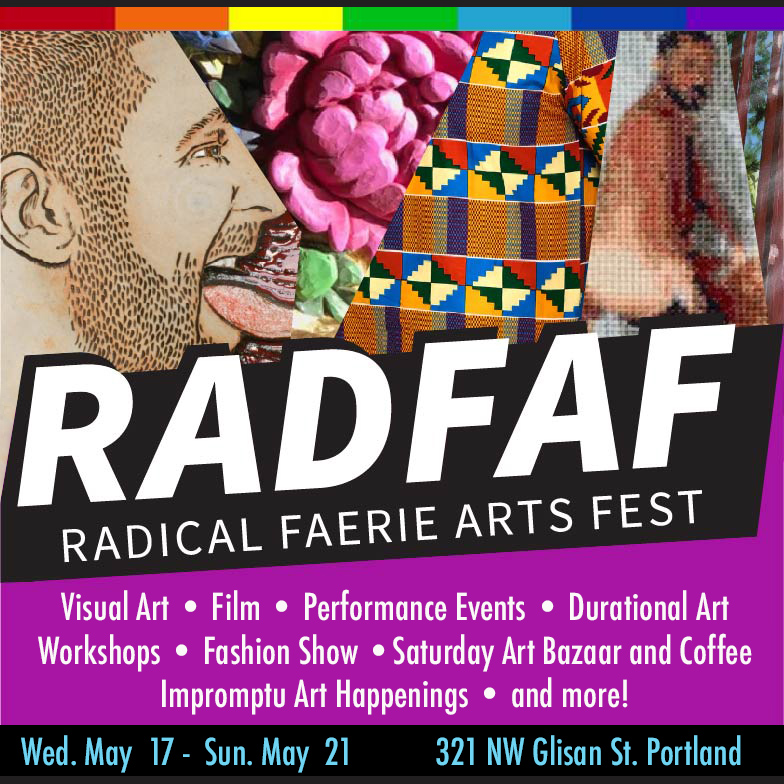
From May 17-21 the Portland Radical Faeries are putting on the first ever Radical Faerie Arts Fest (RADFAF) here in Portland at 321 NW Glisan St. The reception and opening ceremony for the event is tonight, May 17 from 5-9 p.m. The entire festival is completely free. A full rundown of RADFAF can be found here: https://www.radfaf.org

I was asked to perform at RADFAF as a performer, and believe me, I’m happy to participate. I will be performing at our spoken word event, “Faerie Reelness,” on May 18. On May 19 I will be performing at the RADFAF Music/Singer Showcase and will be opening the show.

For my artist’s statement that is included in the program, I stated the following: “I believe storytelling is a human right, not just a civil right. Anything that impedes freedom of speech imperils the rights of those who wish to tell their stories and therefore share their cultures. Storytelling is universal across all societies and belief systems, and therefore the art of telling tales may be considered both a radical and essential act.”

I look forward to seeing you at the Radical Faerie Arts Festival. Be well.

Authentic Storytelling

2 May

My latest article from Voices! Magazine is below. I’ll leave the link for the magazine itself at the end of the article. Enjoy!

What happens when you know you’re right for a part, but the role goes to somebody else?

As an actor, this is very often the case with most roles. When an actor receives a call to go to an audition, he or she will receive “sides,” or a small breakdown of the script which may or may not even be the final copy of the screenplay to memorize before they go for their audition. The role will specify the age range (i.e., 30-45 years old), gender, race, and other factors that the director or producers are looking for from the actor. Although there may be some flexibility in how the role is cast, more often than not, the director has the last word in who makes the final cut. And of course, this can be very frustrating if you actually meet all of the requirements, have a great audition, and still don’t succeed in nabbing the role.

One of my favorite examples of this happened to me in the past decade when I auditioned for a television series called Legit, in which they were looking for an actor who could play a character with a disability. The character in question was named Billy Nugent, and he had muscular dystrophy. I was told that I was in the running for the part along with at least two other actors. As I’m an actor with a facial paralysis thanks to growing up with Moebius syndrome, it was incredible to think that I might have a shot at a major role on a television series.

Only it didn’t pan out that way. Another actor named DJ Qualls beat me to it. As far as I know, the actor doesn’t have any noticeable disability in real life, but he was convincing enough in his audition that he got the part. Congratulations were certainly in order for him; the show lasted for three seasons, which I’m sure gave him a leg up when it came to finding more work later in his career. While I hold no ill will towards DJ, I was reminded yet again that simply having the right stuff doesn’t necessarily ensure that you’re the best fit for the part. And while Hollywood has made strides in auditioning more actors with disabilities to play characters with disabilities, this doesn’t mean that the actor meeting those requirements will get the role.

In fact, it’s still very common for able-bodied actors to play parts that are written for people with disabilities. The reasons vary, but in most situations, the producers are looking for a name actor to fill the part. The challenge, therefore, is in cultivating performers with disabilities who can eventually become name actors themselves. There are plenty of examples of this such as Peter Dinklage, Marlee Matlin, Linda Hunt, and Troy Kotsur, to name but a few. But in order for this to happen, authenticity in casting must take priority, because authenticity always matters.  

As public speakers, we have an enormous advantage compared to our thespian brothers and sisters: We can create our own speeches and thus tell our own stories. And we do so with our own voices, hearts, and minds. We aren’t at the whim of casting agents or producers. We don’t need to worry about television or movie ratings or the politics of Hollywood. And we have the option to be honest about who we are. The key to remember is that we don’t have to ask anyone’s permission to tell our stories. Authenticity always matters. And no one has the right to tell your story but you. When you take the time to be true to yourself, then your personal role can become much clearer.

I acknowledge that I can’t necessarily advise people on how to create their own stories as each person’s situation is unique. I’m also mindful of the fact that not everyone chooses to share their story. The best advice I can offer is that the story will tell itself when it’s ready. I’ve seen this many times when I’ve watched speakers both old and new take the podium and reveal parts of themselves I would never have guessed at. Yes, it’s possible some of them might embellish the truth, and especially in Table Topics, you have the opportunity to outright lie if you want to. But being able to hear someone else’s story is what inspires us to tell our own. Authenticity matters not only in what we say and how we say it. It matters because it allows others into our space in a way that affirms them. It matters because it inspires people to discover or own parts of themselves they may have neglected or thought others would shame them for. And finally, authenticity helps affirm the worth of what you bring to the table. Maybe you won’t be the right person for every part, but as a public speaker, you can decide how to best use your gifts and experience to your advantage.  

https://d7toastmasters.org/project/voices-april-2023/

Celebrating Diversity with the House of Mouse

28 Apr

At some point I’ll get around to writing a longer post about how ironic it is to be singing Disney music during a time when the corporation itself is under attack by Governor DeSantis for being too “woke.” For now, I’ll just thank Disney for being a staunch ally of our community for over 30 years. Our next concert occurs on June 24-25 and features musicians from the Oregon Symphony, which marks our first collaboration ever with them. I’ve included the link. I hope you’ll join us in June for a fantastic weekend full of song and Pride!

Learn to Love Taking Notes!

27 Apr

Hi all. I’ve decided to try a different tack on posting my articles. I will still put the link for the article at the end of this post, but whenever possible, I’d prefer to let you see the full text here. Henceforth you don’t necessarily have to click on the link unless I’m publishing in a magazine that requires it. And if you hit a paywall when that happens, I apologize in advance for that, but the magazines I hope to be published in always want subscribers. Please be patient as we figure this out together.

That said, I encourage you to click on the link to check out Voices! I’ve been in Toastmasters for nearly a decade, and even though I’ll continue to post my articles here, there’s plenty more to see in the magazine. For those of you who might be interested in joining Toastmasters, Voices! gives a lot of advice on public speaking and leadership. Please check it out when you can. This current article can be found on Pages 40-41 of Voices!

Now, on to the article itself!

What happens when you need to create a specific speech, but you can’t clarify all the points you want to make?

Taking notes used to be one of those tasks that I dreaded. I remember when I first learned to take notes back in grade school. At the time, I found it helpful, but only slightly. When your self-esteem isn’t that great to begin with and you’re taking classes like Social Studies where you feel profoundly stupid, the notes only served as a reminder that I had a lot more to learn. Flash forward to my adult years, and I was often asked to take notes for different organizations. Perhaps my least favorite time for note taking also became my most transformative experience for learning how to take notes correctly. From 2013 to 2015, I served on the Talent Committee at the Oregon Media Production Association where we tried to create policy and events that would help actors and other talent excel at their craft. During my first year, I was asked to take notes during our meetings. Not knowing how much information to take down, I ended up recording almost every aspect of the meeting. I was gently taught by a couple of people to summarize the different parts of the meeting by delineating the main points of each subject we covered. Gradually synopsizing the meeting became much easier, though by the time my tenure ended as secretary of our group, I truly hated note taking.

Perhaps not so surprisingly, during my time in Toastmasters, my attitude gradually changed to where I did almost a completely U-turn on taking notes. In two of my clubs, we have the meeting role of the Master Listener. Simply put, the Master Listener listens to the bulk of the meeting, takes notes on each of the speakers, and then gives a pop quiz to the rest of the club near the end of the meeting. One of the benefits of the Master Listener role is that it’s one of the easiest meeting roles to learn for newer members. However, it also provides an interesting challenge as the Master Listener also practices better active listening skills in picking up the various details of the meeting before creating questions for the rest of the club to answer. And as a better active listener, you’re more likely to catch details in the speeches you might have missed otherwise that might prove invaluable to you later as a speaker. As the Master Listener, I used the skills picked up from my time as the committee secretary, took meticulous notes, and enjoyed stumping our members and guests by giving very specific questions related to our meeting. I learned just as much from the experience as they did.

Perhaps the best time for me to take notes is when I’m brainstorming. I love brainstorming, and as someone who writes in multiple genres, brainstorming is a must in most situations to help clarify what it is you want to write. Unlike other forms of note taking, brainstorming is much more freeform, allowing greater flexibility but also eventually needing a way to organize one’s thoughts into a coherent story once you’ve hashed out the details. For example, world-building is one of my favorite activities as a writer of science fiction and fantasy as so many elements go into creating a milieu that is exciting to both the reader and the author. The main drawback in world-building is that you can become lost in your own creation and forget to write the story itself. Brainstorming should ultimately be about creating the environment you want for your speech or essay. I learned that If you’re spending too much time brainstorming, you’re probably overthinking what you want to do on your project. By taking the time to create the main points of my story or speech, I was able to flesh out my goals much more succinctly.

While I can’t always tell you that there are ways to enjoy note taking, certainly there are many benefits to using this skill. As our Club Secretary, for example, I’m able to take part in the direction of my club by recording the events of our executive committee meetings. And that’s perhaps the biggest takeaway. By taking notes for yourself, you ensure that you retain information for a longer period of time so you can improve your skillsets, whether that be as a student or an employee. By taking notes for others, you ensure that the group remains on track and accountable for their actions. And by using note taking as a means to create a speech, you make it possible to keep the speech on-topic by creating bullet points for your subject matter, making it easier for your audience to follow along.

Voices! March 2023

Unique Qualities to Unique Situations

29 Mar

A friend of mine recently asked me the question, “Where are you uniquely suited to offer the most value to others?”

Although I don’t like harping on my facial paralysis too often, I was recently thinking about how I could use my disability to my advantage as an actor. This way of thinking has not always come easily to me. Years earlier, just after I was signed to my talent agency, I was trying to think of ways to avoid having to use my disability, believing that it would be a crutch in finding employment. Actors with disabilities still find very little work in show business, and I was determined to show casting directors that I was more than my disability. However, when you go out for auditions, the casting directors will use what they see, and you only have two minutes (at best!) to showcase what you have to offer. In recent years, there have been more opportunities for actors with disabilities to be seen and heard, and I finally decided to work on finding ways to use my facial paralysis to my advantage.

One of the things that I’ve been wondering about is what it would be like to work in motion capture. In motion capture, sensors are attached to the face and body in order to record the actor’s movements and facial expressions to be used later in animating or enhancing specific characters. An argument could certainly be made that I’d be a poor choice for this performance technology, but then again, no one has ever tried to capture my expression in such a way, either. What would it be like for the technicians working with me if they found that a person with my facial paralysis actually had more going for me than they thought, especially given my many years of performance experience? The idea I’m playing around with is putting together an article called, “What Can You Learn from a Facial Paralysis?” At the very least, I can offer insights into different disabilities. At most, I might be called upon as a disability consultant in show business, though for various reasons that I won’t go into, that situation is fraught with peril, especially since many people with disabilities don’t get properly paid for their services in the industry.

Our Next Concert Is…

22 Mar

I’m pleased to announce that the Portland Gay Men’s Chorus will be performing our next concert, “The Body Electric,” on March 25-26 at the Patricia Center for the Performing Arts in Beaverton, Oregon. Saturday’s concert will begin at 8 p.m., while our Sunday matinee starts at 3 p.m. A full description of the event appears below, and you can get your tickets here: https://thereser.org/event/the-body-electric/

The Body Electric

March 25-26

We, the Portland Gay Men’s Chorus, loudly proclaim that all people have the right to lead lives of freedom, peace, and joy. In these tumultuous times, The Body Electric honors our communities’ never-ending crusade against oppression, the pursuit of a more perfect union, and the inalienable power found within each of us. Join us as we raise our voices in celebration of all that we are and all that we hope to be.

“BE ADVISED: Laser and/or strobe lights are used throughout this performance. Audience members with photosensitivity or a history of seizures/epilepsy may consider caution.”